


The stories behind Kansas memorials honoring legendary coaches, athletes and teams lost too soon
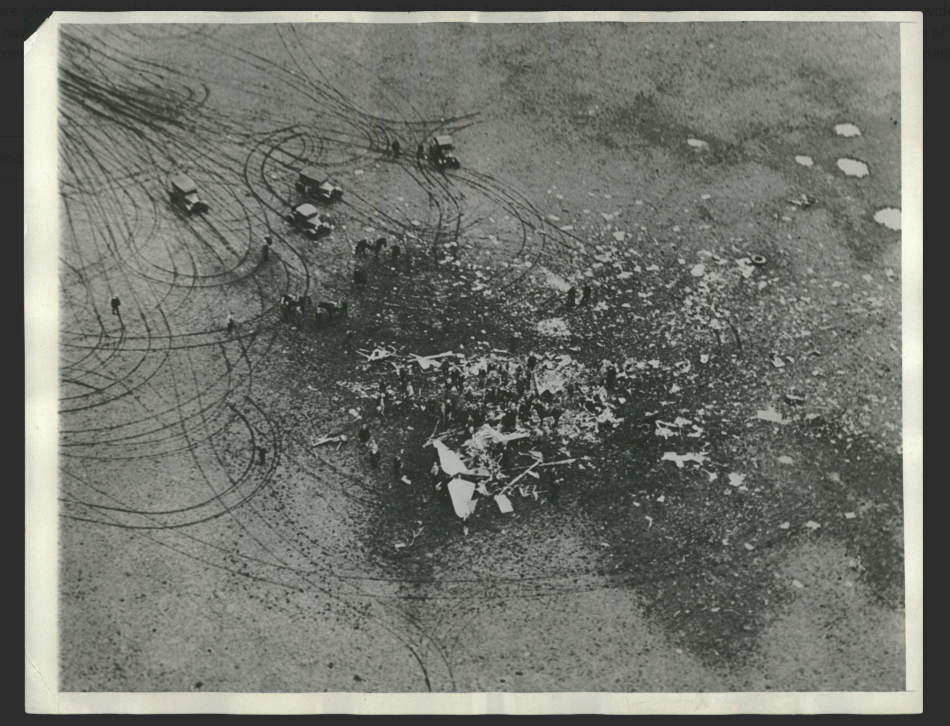
March 31, 1931, was a disastrous day in sports history. A small airplane crashed in the Flint Hills in rural Chase County near Bazaar, killing all eight men aboard. Among the passengers was the University of Notre Dame’s legendary football coach, Knute Rockne.
The day after the accident, the Kansas City Star reported that Rockne had been visiting his two sons, who attended school in Kansas City. According to the Knute Rockne Memorial Society, he was headed to Los Angeles for speaking engagements and to meet with film studios about a proposed motion picture celebrating Notre Dame football. It wasn’t until after his death, in 1940, that a movie about his football career was released: Knute Rockne, All American, starring Pat O’Brien.
Rockne, the mastermind behind Notre Dame’s gridiron record, had led his teams to national championships in 1924, 1929 and 1930. The accident drew national attention and, in the weeks that followed, hundreds of Kansans visited the crash site. Now, 95 years after the crash, memorials across Kansas honor his legacy.
Four years after the accident, a monument was erected at the crash site, which is on private property. The names of all eight passengers were etched into its granite surface.
About 14 miles southwest of the crash site, along U.S. 50, a historical marker highlights Chase County and the Bluestem Pasture Region, and, in passing, notes that Rockne died nearby.
In 1965, another memorial marker was raised, this time at the Matfield Green service area on the Kansas Turnpike, just 8 miles from the crash site. When the turnpike’s new service area opened in 2004, the Kansas Turnpike Authority replaced the marker with a more substantial memorial inside the center. The 175-square-foot exhibit featured large photographic panels describing various aspects of Rockne’s life, audio clips from his famous motivational speeches, and a life-sized cutout of the man himself.
Several years later, after the service area was renovated, part of the display moved to the Chase County Historical Museum and Library in Cottonwood Falls. Today, it has been incorporated into an exhibit featuring Rockne and the crash, according to the museum’s director and curator, Dawn Sisson.
“We put up four of the panels,” Sisson says. “One has a large picture of Rockne in his football uniform when he played football for Notre Dame, one is more of a headshot of Rockne, and the others talk about the plane and the crash.”
The display includes pieces of the wreckage, such as the plane’s propeller, as well as photographs, official documents, extensive newspaper accounts and other memorabilia. A 1932 Rockne Studebaker, named for the coach, is also on display, on loan from the Rockne family.
“They purchased it in the mid-1980s and refurbished it,” Sisson adds. “They were going to put it into storage but asked if we would like to have it on loan because they would rather have it out where people could see it.”
Another part of the display features Easter Heathman, a Chase County resident who was among the first to arrive at the crash scene.
“Heathman was only 13 years old at the time of the crash,” Sisson says. “Because he was so young and it left such a big impression on him, he became the storyteller and memory keeper.” Heathman devoted most of his life to maintaining the Rockne memorial and offering tours of the crash site.
In 2019, the Kansas Turnpike Authority partnered with the University of Notre Dame to add a bronze bust of Rockne to the memorial inside the Matfield Green service area.
Rockne coached at the University of Notre Dame from 1918 to 1931. He won 88% of his games, a record that stood for more than 50 years as the highest winning percentage of any college or professional football coach. Rockne was inducted into the inaugural class of the College Football Hall of Fame in 1951.
| 620.273.8500
Jesse Harper Memorial
Ashland
Jesse Harper was another household name in football. In 1913, during his first year as head coach at Notre Dame, he employed the forward pass to upset the Army Cadets, 35-13. Although the move was legalized in 1906, most teams used it only once or twice a game. Harper’s willingness to unleash it against this powerhouse put Notre Dame on the map and changed the game forever. His star player was Knute Rockne.
“He’s the one who taught Rockne to play,” explains Pioneer-Krier Museum director Tony Maphet. “Rockne was one of his star players.”
Before ending his coaching career four years later, Harper helped Rockne secure the spot as his successor. During this time, Harper ranched in Clark County and served as president of the Kansas Livestock Association. In 1931, he was only 100 miles away when he heard that his friend was in a plane crash.
“Harper was called when that plane went down,” Maphet explains. “He identified the body.” He accompanied Rockne’s body on the train from Kansas to South Bend, Indiana.
Shortly after the crash, Notre Dame asked Harper to serve as its athletic director, a position he held until 1934. He returned to ranching and, following his death in 1961, was inducted into the National Cowboy & Western Heritage Museum’s Hall of Great Westerners for blending athletic leadership with ranching ethos.
Today, the Pioneer-Krier Museum in Ashland honors Harper with a special exhibit that showcases several of his belongings, including items from his years at Notre Dame.
/ 620.635.2227
Memorial ’70
Wichita
Another disastrous day in college sports history was October 2, 1970. In preparation for a football game against Utah State University, Wichita State University football players, athletic staff members and team boosters boarded two planes bound for Logan, Utah. The plane designated the Black Plane made it safely to its destination. The other plane, the Gold Plane, did not.
It crashed into the side of a mountain near Silver Plume, Colorado, along present-day I-70. With 36 passengers and a crew of four on board, only nine people survived. Pieces from the crash still remain at the crash site.
Each October 2, in remembrance of the crash, a wreath is placed at Wichita State’s Memorial ’70 on the west edge of campus. Here, two monuments honor the victims of that flight, one bearing the names of the 31 victims. Also to honor the deceased, a display case featuring photographs and mementos is located in the Koch Arena concourse.
On the 50th anniversary of the crash, a survivors’ monument was designed in the shape of a fuselage, the area of the plane that broke and allowed the survivors to escape the wreckage. The monument is positioned between the two original Memorial ’70 structures and lists the name of the eight football players who survived the crash. The names of the teammates aboard the Black Plane, which landed safely, were added to the back of the upright monument.
/ 316.978.3142
